Direct answer
What counts as a Telegram crypto signal red flag?
A Telegram crypto signal red flag is an observable gap between what a group asks you to trust and what you can independently check. The gap may concern route ownership, performance records, risk controls, commercial terms, payment identity, support, a bot, or exchange access. One gap should trigger a narrower question. Several unresolved gaps around payment or account permissions should stop the transaction until the evidence changes.
Do not turn a warning into an accusation. A changed handle can have an ordinary explanation. An anonymous analyst can still publish a complete record. A deleted message can be a correction. The due-diligence question is whether the provider preserves enough chronology and accountable contact to explain the change before asking for money, personal information, a deposit, or trading authority.
Guaranteed returns, an unsolicited investment message, pressure to send cryptocurrency to a direct-message contact, or a request for withdrawal-enabled exchange access should end the process until an independently attributable route and controlling terms are established.
Browser-local decision tool
Triage the route, payment, proof, and access chain before you proceed.
This tool turns ten observations into the first unresolved evidence gate. It uses no provider name, wallet address, account identifier, safety score, or profitability estimate. Answers stay in this browser page and are not submitted or stored by CryptoSignalsReview.
Route and payment evidence triage
Find the next evidence request, not a provider verdict.
Hard-stop observations take precedence. Passing every gate means documented for deeper review, not verified.
How the six evidence states are assigned
The decision order is fixed. A guaranteed-return claim, unresolved deposit route, personal or direct-message crypto wallet, withdrawal or seed access, or a payment-linked direct-message identity change produces the stop state first. Otherwise the tool checks official-route attribution, accountable seller and durable terms, permission scope and a tested exit, then a complete signal chronology with a material-change log.
The final state is deliberately named Documented for deeper review, not verified. It opens the next evidence method; it does not recommend payment, connection, a provider, or a trade. A deadline remains visible as a caution even when the other fields are complete.
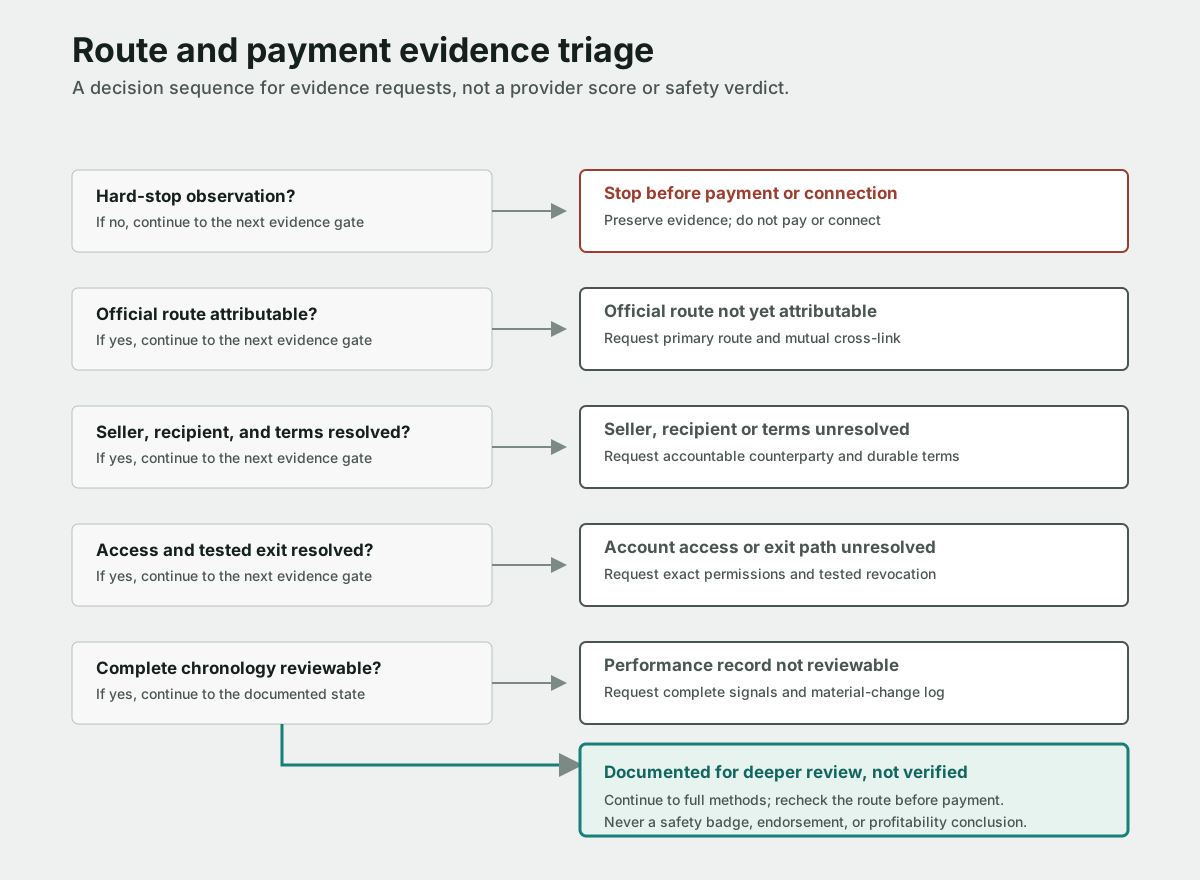
| State | What it means | What it does not mean |
|---|---|---|
| Stop before payment or connection | At least one hard-stop observation requires the reader to avoid sending funds or granting access while preserving evidence and using an independently sourced reporting or support route. | This state is not a legal finding, provider rating or claim that every surrounding route is fraudulent. |
| Official route not yet attributable | The exact Telegram route cannot yet be tied to a provider-controlled primary route with enough continuity to evaluate later evidence. | A missing cross-link does not prove impersonation or misconduct. |
| Seller, recipient or terms unresolved | Route evidence may exist, but the payable commitment and accountable counterparty are incomplete or changed. | This state does not judge whether a named seller will honor a payment or refund. |
| Account access or exit path unresolved | Requested permissions, revocation, cancellation, data deletion or evidence-preservation steps remain incomplete. | A trade-only or read-only label is not treated as a safety guarantee. |
| Performance record not reviewable | The route and commercial chain may be attributable, but the complete signal chronology and material edit/deletion record are not available. | Missing or selected proof is not proof that published outcomes are false. |
| Documented for deeper review, not verified | All ten answers avoid the defined blocker conditions, so the reader can continue to the full evidence methods while rechecking the route immediately before payment. | This state is never a safety badge, verification mark, endorsement, profitability conclusion or recommendation to pay. |
Build the evidence request around the first unresolved gate
Ask for attributable records, not reassurance. Route evidence identifies where the offer started. Counterparty evidence identifies who is taking responsibility for the commitment. Access evidence identifies what a bot, copier, exchange connection, or account permission can do and how it is revoked. Record evidence supports later performance reconstruction. Reporting evidence preserves the route reached independently if a hard-stop observation requires escalation.
Route evidence
- Current provider-controlled primary URL
- Exact Telegram username or invite route
- Return link or other current cross-confirmation
- Capture time and route role
Counterparty evidence
- Named seller or legal operator
- Invoice issuer
- Payment recipient and explanation for any difference
- Durable price, renewal, cancellation, refund and access-removal terms
Access evidence
- Bot or integration controller
- Exact permission list
- Revocation and data-deletion steps
- Tested cancellation or disconnect path
Record evidence
- Complete issued-signal chronology
- Predeclared inclusion and outcome rules
- Material edit/deletion log
- Fill, fee and closure evidence
Reporting evidence
- Preserved route and payment captures
- Transaction receipt or identifier without exposing secrets
- Platform report route reached independently
- Relevant regulated or law-enforcement route where appropriate
Do not put API secrets, seed phrases, full wallet credentials, identity documents, or private account data into this page or an evidence request. Preserve only the minimum route, terms, receipt, permission, and chronology material needed to establish what changed and who controlled each step.
Official sources define general cautions, not provider conclusions
- U.S. Commodity Futures Trading Commission: Use Caution Responding to Messaging Apps - General messaging-app caution and independent official-route confirmation.
- U.S. Federal Trade Commission: What To Know About Cryptocurrency and Scams - General crypto-payment reversibility, seller-attribution and guaranteed-return caution.
- Telegram: Channels FAQ - Platform mechanics for public usernames, links, administrators and message deletion.
- Telegram: Telegram FAQ - Platform reporting and impersonation-reporting routes.
These sources explain messaging, payment, route, deletion, and reporting mechanics. They do not classify a provider covered by this page. The 96 downloadable rows are synthetic contract fixtures for testing the decision sequence, not observed providers or prevalence estimates.
Message-level evidence check
Paste one Telegram signal message to separate missing trade fields from warning language.
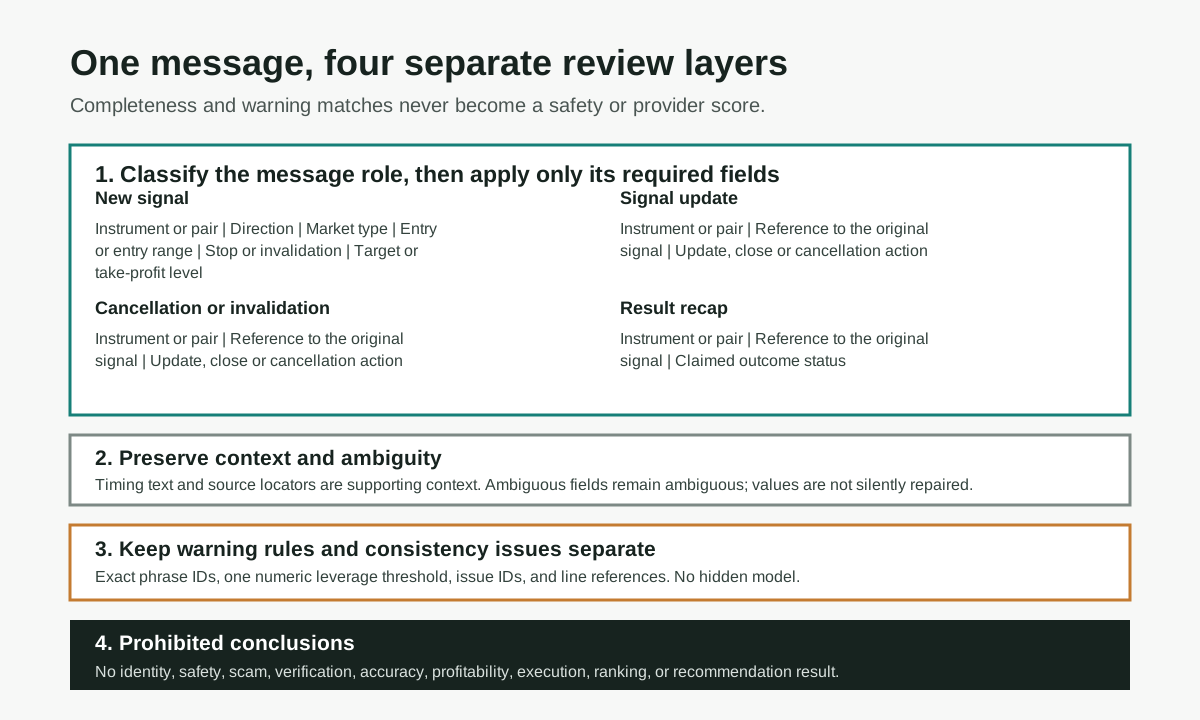
The route and payment triage above asks who controls the route, commitment, permissions, and exit. This second tool does a different job: it classifies one pasted message as a new signal, update, cancellation, result recap, promotion, or unclear text, then applies only the fields relevant to that role. It also reports exact language patterns that deserve independent review. It does not authenticate the sender, validate a price, score a provider, or decide whether the message is safe.
Different message roles require different evidence fields.
A new signal requires an instrument, direction, market type, entry, stop or invalidation, and target. An update or cancellation requires an instrument, original-signal reference, and action. A result recap requires an instrument, original-signal reference, and claimed outcome. Promotions and unclear text receive no forced completeness verdict. Timing text and a durable message locator remain supporting context because Telegram posting, edit, and forward metadata usually sit outside copied text.
Phrase matches remain separate from signal completeness.
Guaranteed returns, cannot-miss claims, extreme percentages, urgency, FOMO, coordinated buying language, direct crypto payment requests, release fees, loss-recovery promises, credential requests, remote access, withdrawal permissions, unsolicited-group context, and leverage of 50x or greater are transparent review prompts. A complete message can still contain warnings. An incomplete message can contain none. Neither condition becomes a safety score.
Pattern matching is intentionally narrow. It recognizes English labels and common market abbreviations, so an unmatched phrase is not evidence that a risk is absent. The analyzer does not use a language model, sentiment score, provider database, remote API, or hidden classifier.
Downloads preserve the observation without copying the message.
The JSON report contains field IDs, warning IDs, line numbers, method date, and the decision boundary. It deliberately excludes the original message and matched fragments. Review and redact any report before sharing it. The analyzer cannot reconstruct deleted or prior versions, so preserve a permalink and visible timestamp separately when evidence handling matters.
Official advisories define general prompts, not provider conclusions.
- U.S. Commodity Futures Trading Commission: Use Caution Responding to Messaging Apps - General messaging-app warning-language categories.
- Financial Industry Regulatory Authority: Investor Alert: Social Media Investment Group Imposter Scams Continue to Rise - General investment-group, impersonation, deposit-pressure and recovery-promise categories.
- U.S. Securities and Exchange Commission Investor.gov: Social Media and Stock Tip Scams - Investor Alert - General social-tip, impersonation, guarantee and urgency categories.
- Financial Industry Regulatory Authority: Crypto Assets - General crypto-volatility, social-message and FOMO boundary.
These sources support general review categories. They do not classify a message pasted into this page, establish the identity of its author, or prove misconduct by a named provider. The synthetic fixtures contain no observed provider message and no prevalence estimate.
Fixed-cohort context
Telegram is common in the researched cohort, but route control is often incomplete.
In CSR's fixed 2026-07-10 cohort, the official-channel and Telegram route audit found Telegram or t.me language in 15 of 16 provider packets. Eight of 16 had either a dormant, historical, reassigned, same-name, cross-link, or alias-collision posture. Only five fit the two stronger provider-controlled route postures: two site or app primary routes and three mutually attributable site-plus-messaging routes.
The same cohort's 16-provider performance-claims audit found 11 dossiers with provider-published claims but no complete independently reproducible result record. These are dated cohort findings, not estimates of the Telegram market and not verdicts on every group. They show why route attribution and result reconstruction should be completed before a reader relies on a familiar name or a percentage.
Pre-payment checklist
Check these 12 red flags before paying or connecting an account.
1. The Telegram route does not match the provider's primary site
A matching name, logo, subscriber count, or forwarded message does not establish control. Begin with a provider-controlled website or app and follow its current link to Telegram. Then check whether the Telegram account links back to the same primary route. Keep same-name channels, support handles, bots, result channels, and old usernames separate until the cross-links prove continuity.
2. Profit is described as guaranteed, risk-free, or nearly certain
No signal can remove market, execution, liquidity, leverage, operational, or counterparty risk. Treat oversized-return promises and claims of little or no risk as a stop condition. Ask what can lose, how much capital is at risk, what invalidates a trade, and which complete loss-inclusive record supports the statement.
3. Payment urgency replaces inspectable terms
Countdowns, "last seats," a promised next pump, or a temporary VIP price can pressure a buyer to act before identifying the seller. A legitimate deadline does not remove the need for the payable amount, billing period, renewal, cancellation, refund, access-removal, and dispute terms. Capture the controlling page before payment.
4. Screenshots and testimonials are the only performance proof
A winning screenshot can be genuine and still omit losing calls, open positions, missed entries, edits, fees, funding, drawdown, and the full denominator. Testimonials add experience claims, not an independently reconstructed account. Ask for a complete export covering a fixed period and stable signal IDs.
5. Calls can be edited or deleted without a visible record
Telegram permits channel messages to be edited and deleted. That feature is not evidence of manipulation by itself. The red flag is the absence of an archive, edit policy, tombstone, or result-sheet reconciliation that makes material changes visible. Original entry, stop, target, leverage, and timestamp fields should remain attributable after an update.
6. Losses, break-even calls, no-fills, and open trades disappear
A win rate is not meaningful until every published alert has one status and the statuses sum to the stated population. Require wins, losses, break-even, open, cancelled, invalidated, duplicate, and no-fill records. Do not accept a denominator that removes unfavorable outcomes after they are known.
7. Signals have no stop, invalidation, or risk-per-trade rule
An entry and target without a loss boundary cannot be compared responsibly. The group should state what makes the setup wrong, when the position closes, how much account capital is exposed, and how simultaneous trades are handled. A later instruction to "hold" is not a substitute for a pre-trade invalidation rule.
8. High leverage, martingale, or averaging down is normalized
Leverage can magnify losses and liquidation risk. Adding to a losing position can make many trades appear to recover until one adverse move dominates the account. The provider should name margin mode, leverage ceiling, maximum additions, combined stop, peak exposure, and the account drawdown created by the full sequence.
9. Target touches are presented as realized account return
A market touching one target does not prove the full position exited there. Multi-target signals need weights, remaining position, stop movement, fill rules, and closure time. Summed leveraged target percentages are not whole-account return without starting capital, position size, concurrency, costs, and an equity curve.
10. Price, renewal, refund, or access-removal terms are hidden
A monthly-looking price may require several months of prepaid cash. A discount may renew at another amount. A refund statement in chat may conflict with the checkout page. Use the commercial-terms audit method and the paid-signals break-even audit to separate displayed price from complete commitment and value.
11. Payment moves to a direct message, personal wallet, or new identity
Compare the checkout operator, invoice issuer, payment recipient, wallet label, support account, and refund counterparty. A last-minute route change can break the attribution chain even when the main channel is genuine. Cryptocurrency transfers can be difficult to reverse, so do not let chat urgency substitute for a named seller and durable receipt.
12. A bot, deposit, UID, or API permission is required before proof
A bot can add another operator, privacy policy, data-retention path, payment recipient, or exchange referral. An API key with trade permission can place real orders even when withdrawals are disabled. Before connecting anything, use the API and automation access audit to identify the controller, exact scope, revocation path, subaccount boundary, and failure behavior.
Five-minute route check
Confirm the official Telegram route before evaluating the offer.
- Start outside Telegram. Type or independently locate the provider's primary domain or app. Do not begin from a sponsored search result, forwarded invite, community post, or direct message.
- Follow the current first-party link. Record the exact channel, group, bot, and support handles linked by that route. A provider may use several accounts for different functions; do not merge them by name alone.
- Check the return link and history. Look for a link back to the same domain, a consistent public history, and a current post that identifies the role of the route. A dormant channel can remain attributable historically without proving a current offer.
- Keep later counterparties separate. A payment processor, exchange referral, broker, bot, copier, admin, or wallet can belong to a later step. The first-party link does not verify every downstream endpoint.
- Recheck immediately before payment. Compare the route, seller identity, amount, terms, and recipient with the evidence you captured. Stop if a direct message changes any of them.
The purpose is attribution, not a safety badge. A mutually linked website and Telegram channel can establish where a named offer is presented while leaving the legal operator, payment recipient, support accountability, security controls, and performance claims unresolved.
Proof check
Reconstruct a complete period instead of inspecting selected winners.
Ask for one fixed date window and one named product or channel. Every published signal should have a stable ID, original timestamp, market, direction, entry rule, stop or invalidation, target allocation, leverage and sizing rule, edit history, and final or open status. The provider should state which records are eligible before the rate is calculated.
Then rebuild execution. Name the venue, product, order type, bid or ask convention, allowed latency, partial-fill rule, missed-entry rule, stop execution, target weights, fees, spread, slippage, funding, and subscription cost. Apply the same rule to winners and losses. A reproducible calculation is more useful than a screenshot, but it still does not guarantee that the source records are complete or predict future results.
Finally, translate trades into an account path. State starting capital, position size, leverage, margin mode, concurrent exposure, compounding, open-equity treatment, maximum drawdown, losing streak, and recovery time. A win rate measures classification under one denominator. It does not establish profitability, survivability, or suitability.
Payment and access
Verify the complete commitment and the exit route before sending funds.
Record the exact payable amount, currency or token, billing period, prepaid commitment, automatic renewal, cancellation deadline, refund eligibility, access-removal rule, support route, invoice issuer, and payment recipient. If the terms exist only inside a private chat, ask for a durable copy tied to the seller. If the checkout and Telegram statements conflict, the claim remains unresolved until the controlling terms are clear.
Plan the exit before the entry. Determine how to cancel, revoke bot access, delete stored data, rotate an API key, remove a copier, disconnect an exchange, and preserve a receipt or dispute record. A low monthly equivalent does not repair a long prepaid commitment or an untested cancellation path. A free trial does not justify broad account permission.
Official context
Messaging and crypto advisories reinforce the pause-and-verify rule.
The CFTC messaging-app advisory warns about unsolicited groups, guaranteed oversized returns, leveraged crypto pitches, and requests arriving through apps including Telegram. The FTC cryptocurrency scam guidance highlights social-media contact, guarantees, impersonation, payment in cryptocurrency, and claims made without details.
Telegram's own channel FAQ explains that channel messages can be deleted for all subscribers and that public channels use usernames and links. Its main FAQ describes in-app reporting and an impersonation route. Those platform features help explain why a provider-side archive and current first-party cross-link matter. They do not establish that a specific group is unsafe or that Telegram endorses this checklist.
Common questions
Short answers without false certainty.
Is an anonymous Telegram admin automatically unsafe?
No. Anonymity increases the identity and recourse questions, but it does not prove bad intent. Require a stable official route, accountable support, named payment recipient, durable terms, and complete evidence. Keep unresolved identity visible rather than inventing a person or company.
Are winning screenshots evidence?
They can document selected messages or market movement, but they cannot establish a loss-inclusive rate or account return by themselves. Ask for the full population, original chronology, execution rules, costs, open positions, and drawdown.
Does a deleted or edited call prove manipulation?
No. Corrections and cancellations can be legitimate. The evidence question is whether material changes remain visible through an archive, edit history, tombstone, or reconciled result sheet. Missing history keeps the claim unresolved.
Is a trade-only API key safe?
Disabling withdrawals reduces one permission, but trade authority can still create losses. Use a segregated subaccount, minimum required scope, no withdrawal permission, IP restrictions where supported, alerts, an exposure limit, and a tested revoke or emergency-stop path. These controls reduce risk; they do not guarantee safety.
Should a red flag change a provider's ranking?
CSR does not sell ranking changes or turn one warning into a score. A red flag changes the evidence question and safest next action. Verified status, risk notes, and conclusions change only when attributable evidence changes.
How CSR uses this checklist
Red flags set an evidence state, not a rumor score.
CryptoSignalsReview can leave a provider under review, request access, record a route collision, or state that evidence is insufficient without calling the provider fraudulent. Coverage is not endorsement. Missing proof is not proof of misconduct. A provider can submit corrections and attributable records, but paid production, sponsored visibility, or profile work cannot buy verified status, ranking position, risk-note changes, or a positive conclusion.