Interactive calculation
Calculate the ratio only after losses and unresolved rows stay visible
Profit factor compresses a supplied result population into one ratio. That convenience is also its main risk. A ratio can look strong because the numerator contains one exceptional row, because unfavorable observations were excluded, because open calls have not resolved, or because fees and execution costs were never deducted. This analyzer therefore begins with the components and the row boundary instead of presenting a favorable ratio as a verdict.
Use one row per durable signal identifier. Mark closed outcomes as win, loss, or break_even and provide their cost-adjusted net_r. Keep open, cancelled, and no_fill rows in the file: they are counted as exclusions but do not enter the aggregate. A result set with no negative resolved row receives a not-calculable state. The interface never substitutes infinity, because a missing denominator does not establish unlimited quality.
Loss-inclusive net-R CSV
Required: signal_id, outcome, net_r. Optional: closed_at_utc, source_url, fees_included, notes. Input is processed locally and is not stored by this page.
Metrics stay suppressed until a structurally usable result set is analyzed.
| Severity | Code | Row | Message | Repair |
|---|
Exact model
The numerator and denominator are separate audit objects
For this method, gross positive net R is the sum of every positive numeric net_r among resolved rows. Absolute gross negative net R is the magnitude of the sum of every negative numeric net_r among resolved rows. Observed profit factor is the first amount divided by the second. Break-even rows contribute zero but remain in the resolved count. The numeric sign controls the arithmetic even when a marketing outcome label disagrees, and that disagreement produces a visible warning.
profit factor = sum(positive resolved net R) / abs(sum(negative resolved net R))The unit remains R. It does not become a percentage return, currency return, annualized return, risk-adjusted return, account curve, or portfolio value. Converting normalized R into account performance would require starting equity, realized position size, compounding, leverage, concurrent exposure, deposits and withdrawals, liquidation events, actual fills, and every cost. This analyzer has none of those inputs and does not infer them.
A positive numerator with no negative denominator does not create a meaningful infinite score. It creates a missing-denominator state. The set may be too short, selected, still open, missing losses, or genuinely contain no negative resolved row within its declared cutoff. Those possibilities require evidence; the arithmetic alone cannot choose among them. When the numerator is zero and negative rows exist, profit factor is zero. That value still describes only the supplied population.
Outlier sensitivity
One largest win can dominate an attractive aggregate
Largest-win concentration divides the largest positive resolved row by gross positive net R. A result of 60 percent means that one row contributes 60 percent of all positive net R in this supplied set. It does not mean the row is false, manipulated, lucky, or repeatable. It means the aggregate is arithmetically dependent on one observation and that observation deserves direct source review.
The leave-one-largest-win-out calculation removes exactly one row: the first input occurrence among tied largest positive values. It then recalculates profit factor against the same gross negative denominator. The analyzer does not remove multiple winners, search for the most favorable removal, reorder rows, or optimize a threshold. If the original ratio is at least one and the one-row result falls below one, a sensitivity prompt appears. Crossing that reference is not a hypothesis test and has no declared confidence level.
The fixed 50 percent concentration prompt and 30-row context prompt are interface review triggers, not industry standards. They do not separate good from bad providers and must not be used as trading rules. A 49 percent contribution can still be important; a 51 percent contribution can still be genuine. The purpose is to interrupt ratio-only reasoning and direct attention to the row that most changes the conclusion.
Largest-win share
largest positive row / gross positive net R * 100
Shows contribution concentration inside the positive component.
Leave-one-out ratio
(gross positive net R - first largest positive row) / gross negative net R
Shows one-row sensitivity without claiming a future distribution.
Population boundary
Open, cancelled, and no-fill rows remain visible outside the aggregate
An aggregate can become misleading when excluded rows silently disappear. This tool counts open, cancelled, and no_fill rows but does not include them in positive R, negative R, total net R, or profit factor. A nonzero net-R value on one of those rows produces a warning because the label and realized amount need reconciliation. An unknown or omitted fee state also remains visible.
Exclusion is not the same as irrelevance. Open positions can hold unrealized risk, cancelled calls can reveal publication behavior, and no-fill outcomes can matter when a claimed entry was never executable. Those questions belong in a broader evidence review. The narrow calculation stays honest by showing what it omitted and refusing to convert the omitted rows into guessed returns.
The CSV should represent a declared population and cutoff, not a hand-selected collection of attractive examples. Reconcile the row count against the source channel or result sheet, retain losses and break-even outcomes, document edits and deletions, and explain duplicate or revised calls. Structural acceptance only means the supplied text can be parsed under this method. It does not establish that the file is complete or authentic.
Cost boundary
Net R needs an explicit fee and execution policy
The optional fees_included field accepts yes, no, unknown, or blank. Only yes avoids a visible prompt. This is intentionally strict: exchange fees, spread, funding, slippage, partial fills, missed entries, subscription charges, transfer costs, taxes, and execution delay can change the result a follower actually experiences. A provider-authored gross result is not automatically net performance.
Even a fee-confirmed row may not represent another user. R can be defined differently across sources, position sizes can change, leverage can amplify account consequences, and simultaneous calls can compete for margin. This tool accepts the numeric unit as supplied so it can audit internal arithmetic. It does not certify the unit definition or translate it to a wallet balance.
Synthetic worked example
Five positive R, 1.5 negative R, and one row supplying 60 percent of gains
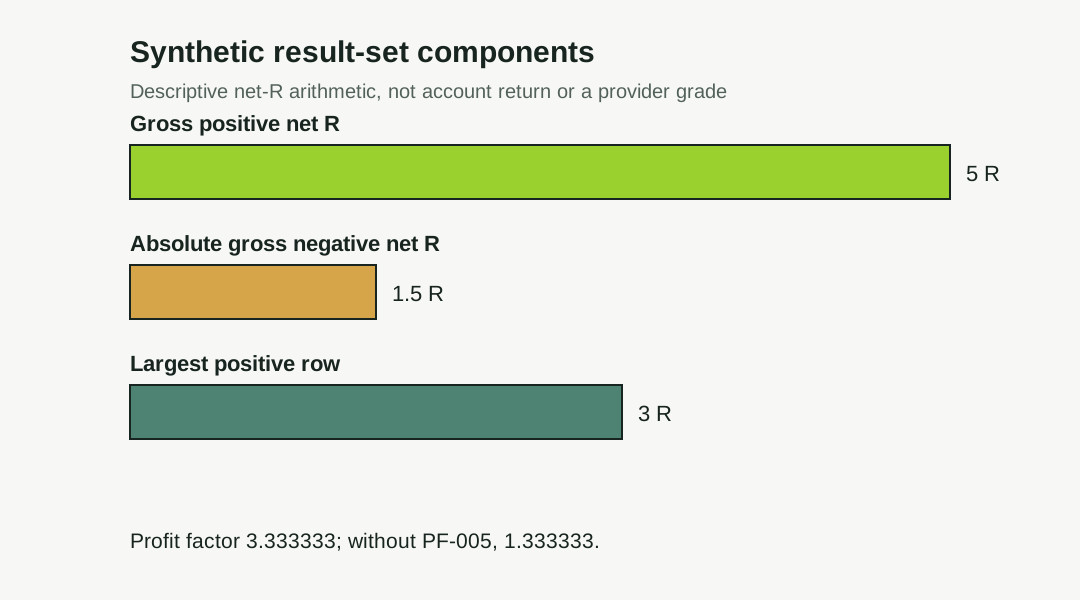
The synthetic starter contains 6 resolved rows and 2 excluded rows. Gross positive net R is 5; absolute gross negative net R is 1.5; total resolved net R is 3.5. Observed profit factor is 3.333333. The PF-005 row contributes 3 R, or 60% of gross positive net R. Removing it once changes profit factor to 1.333333.
The headline ratio remains above one after the removal, but the 60 percent share still triggers concentration review. The open row and unknown fee state keep the result in the visible-gaps state. This is the intended reading order: components first, exclusions and costs second, sensitivity third, ratio fourth. Every row is invented and represents no provider, account, exchange, market period, or trading recommendation.
Download the synthetic CSV and compare it with the machine-readable fixture results. Both files are deterministic release evidence, not performance datasets.
Deterministic fixtures
Ten cases cover denominator failure, concentration, malformed CSV, and evidence gaps
The generator calculates every fixture before writing public output. The independent checker repeats the parser and arithmetic separately, executes the embedded browser core, probes hostile CSV limits, and compares two complete generations byte for byte. Invalid structures suppress all metrics. Warnings keep arithmetic visible only when their limits can remain explicit.
| Fixture | State | Rows | Issues | Profit factor | Largest-win share | Without largest win |
|---|---|---|---|---|---|---|
CONCENTRATED-STARTERSynthetic set with one concentrated positive row and two visible exclusions | calculated_with_gaps | 6 resolved; 2 excluded | fees_not_confirmedsmall_resolved_setlargest_win_concentration | 3.333333333333 | 60% | 1.333333333333 |
MANUAL-REVIEWSynthetic diversified positive rows with confirmed fees | calculated_for_manual_review | 5 resolved; 0 excluded | small_resolved_set | 2.7 | 37.037037037037% | 1.7 |
LEAVE-ONE-OUT-REVERSALSynthetic set whose profit factor crosses the fixed reference after one-row removal | calculated_concentrated | 4 resolved; 0 excluded | small_resolved_setlargest_win_concentrationleave_one_out_reversal | 1.25 | 80% | 0.25 |
NO-LOSSESSynthetic resolved set with no negative denominator | not_calculable_no_losses | 3 resolved; 0 excluded | no_negative_rowssmall_resolved_setlargest_win_concentration | Not calculable | 66.666666666667% | Not calculable |
ALL-LOSSESSynthetic resolved set with zero gross positive R | calculated_for_manual_review | 2 resolved; 0 excluded | small_resolved_set | 0 | Not calculable | 0 |
SIGN-MISMATCHSynthetic set with outcome labels that conflict with numeric signs | calculated_with_gaps | 3 resolved; 0 excluded | outcome_sign_mismatchsmall_resolved_setlargest_win_concentrationleave_one_out_reversal | 1 | 100% | 0 |
DUPLICATE-IDDuplicate durable identifier fails closed | invalid | 2 resolved; 0 excluded | duplicate_signal_idfees_not_confirmed | Suppressed | Suppressed | Suppressed |
MALFORMED-QUOTEUnclosed quoted field fails closed | malformed | 0 resolved; 0 excluded | malformed_csv | Suppressed | Suppressed | Suppressed |
FORMULA-IDFormula-like identifier remains text and visible | calculated_with_gaps | 2 resolved; 0 excluded | formula_like_signal_idsmall_resolved_setlargest_win_concentrationleave_one_out_reversal | 2 | 100% | 0 |
EXCLUDED-NONZERONonzero open row remains excluded and visible | calculated_with_gaps | 2 resolved; 1 excluded | excluded_nonzero_net_rfees_not_confirmedsmall_resolved_setlargest_win_concentrationleave_one_out_reversal | 2 | 100% | 0 |
Repair reference
Stable issue codes separate structural errors from review prompts
Errors prevent aggregate output because calculating around them would require a guess. Warnings preserve the calculation while naming a limitation that a reviewer should resolve. The fixed code supports repeatable checks and machine-readable exports; the message and repair instruction support a person reviewing the file.
| Code | Severity | Scope | Repair |
|---|---|---|---|
empty_input | error | file | Paste or load a UTF-8 CSV with a header and at least one data row. |
input_too_large | error | file | Reduce the file to the published byte and row limits without selecting only favorable outcomes. |
file_read_failed | error | file | Choose a readable UTF-8 CSV or paste the same complete result population. |
malformed_csv | error | file | Repair quoting, delimiters, or line endings under the documented CSV grammar. |
missing_required_column | error | header | Add signal_id, outcome, and net_r exactly once. |
duplicate_column | error | header | Keep each normalized column name once. |
too_many_columns | error | header | Remove unrelated columns or split the audit without changing the result population. |
too_many_rows | error | file | Use a documented complete period within the row limit; do not cherry-pick a favorable subset. |
row_width_mismatch | error | row | Make the row contain the same number of fields as the header. |
cell_too_long | error | cell | Shorten the cell without hiding material result evidence. |
duplicate_signal_id | error | row | Use one durable identifier per result row or reconcile documented revisions before analysis. |
invalid_signal_id | error | row | Use a nonblank identifier of 80 characters or fewer so each resolved or excluded row can be traced without guessing. |
formula_like_signal_id | warning | row | Treat the identifier as text before opening exports in spreadsheet software. |
invalid_outcome | error | row | Use win, loss, break_even, open, cancelled, or no_fill. |
invalid_net_r | error | row | Use a finite base-10 number for resolved rows and leave excluded rows blank or zero. |
net_r_out_of_range | error | row | Verify the unit and keep net_r within the published defensive bounds. |
net_r_precision_exceeded | error | row | Provide at most 12 decimal places and document any prior rounding outside this tool. |
outcome_sign_mismatch | warning | row | Reconcile the marketing outcome label with the numeric net-R sign; this tool uses the numeric sign. |
excluded_nonzero_net_r | warning | row | Explain why an open, cancelled, or no-fill row carries realized net R; it remains excluded here. |
invalid_fee_state | error | row | Use yes, no, unknown, or a blank value for fees_included. |
fees_not_confirmed | warning | row | State whether fees, funding, spread, slippage, and subscription costs are included in net_r. |
invalid_source_url | warning | row | Use an absolute HTTP or HTTPS evidence URL or leave the field blank. |
no_resolved_rows | error | file | Include at least one closed win, loss, or break-even row from the documented population. |
no_negative_rows | warning | calculation | Do not display infinity. Verify whether losses, fees, and unresolved outcomes are missing from the population. |
small_resolved_set | warning | calculation | Keep the exact resolved count visible and avoid treating the fixed context threshold as statistical validation. |
largest_win_concentration | warning | calculation | Inspect the largest positive row, its source evidence, and the result after removing it once. |
leave_one_out_reversal | warning | calculation | Keep both ratios visible; crossing the fixed reference after one-row removal is sensitivity evidence, not a forecast. |
Evidence limits
Correct arithmetic can still summarize selected, fabricated, or non-executable rows
The SEC advises readers to understand how a performance claim was calculated, which factors were included or omitted, and how fees and expenses affect the result. It also warns that cherry-picked performance can emphasize profitable observations while excluding losses or unfavorable periods, and that past or back-tested performance does not predict future results. Those boundaries apply even when the division itself is exact.
The CFTC warns that hypothetical trading results were not subjected to actual market conditions. Spread, liquidity, commissions, subscription charges, execution, and consecutive losses can change what a user experiences, while selected historical trades can create an attractive presentation. A result sheet can therefore pass this parser and still contain hindsight, impossible fills, missing losses, stale calls, edited messages, or invented rows.
Use the output to ask better evidence questions. Inspect the largest row against its timestamped source. Reconcile the denominator to every closed loss in the declared period. Verify whether costs were deducted. Check whether open risk, deleted calls, partial exits, and overlapping positions are represented. Compare provider-authored claims with attributable records. The analyzer cannot perform those investigations and never awards verified status.
Method and provenance
One original decision tool extends an existing accuracy and result-sheet cluster
The frozen Search Console archive supports existing interest around the accuracy method, result sheets, and risk-reward page. It does not contain an exact profit-factor query and is not presented as proof of demand for this canonical. The information gain is functional: readers can calculate the ratio, inspect both components, preserve exclusions, quantify largest-row contribution, and run one deterministic sensitivity test instead of reading another definition-only article.
Current Google guidance emphasizes unique, useful, non-commodity content, crawlability, clear structure, mobile usability, and duplicate reduction. It does not require special AI markup, artificial chunking, or an llms.txt file for Google visibility, and it does not guarantee crawling or indexing. This release therefore uses one canonical rather than query-variation child pages. The dedicated text companion serves non-Google retrieval contexts and is not described as a Google ranking device.
OpenAI states that public pages can be eligible for ChatGPT search when OAI-SearchBot can crawl them, but appearance and citation are not guaranteed. Stable labels, visible calculations, accessible status text, explicit issue codes, and a crawlable explanation make the page interpretable to people and browser agents. They do not prove retrieval. Likewise, an HTTP 200 from IndexNow means a changed-URL notification was received, not that a search engine indexed or ranked it.
Bing AI Performance separates total citations, cited pages, sampled grounding queries, page-level activity, and trends. Those fields can reveal whether a page is being referenced, but Bing explicitly separates citation counts from placement, authority, importance, ranking, and the role of a page inside an answer. After publication, the defensible GEO loop is to observe those measured fields and Google's Generative AI report, then improve clarity or evidence where the data supports it.
Source fact
Publisher, URL, access date, capture status, and bounded observation are recorded in the source ledger.
Deterministic output
Fixture states, metrics, hashes, and generated files are reproduced from the frozen source and code.
Editorial interpretation
Review prompts and limitations are labeled as decision aids, not external standards or factual verdicts.
Release identity
Dataset ID, analyzer version, source commit, V3 version, and artifact hashes keep later changes attributable.
| Publisher and source | Accessed | Capture | Boundary used here |
|---|---|---|---|
| Google Search Central Google's Guide to Optimizing for Generative AI Features on Google Search | 2026-07-14 | official-web-extraction-no-local-capture |
|
| OpenAI Publishers and Developers - FAQ | 2026-07-14 | official-web-extraction |
|
| OpenAI Overview of OpenAI Crawlers | 2026-07-14 | official-web-extraction |
|
| Microsoft Bing Webmaster Tools Introducing AI Performance in Bing Webmaster Tools Public Preview | 2026-07-14 | official-web-extraction |
|
| IndexNow Documentation | 2026-07-14 | official-web-extraction |
|
| U.S. Securities and Exchange Commission, Investor.gov Investor Bulletin: Performance Claims | 2026-07-14 | official-web-extraction |
|
| U.S. Commodity Futures Trading Commission Fraud Advisory: Commodity Trading Systems Sold on the Internet | 2026-07-14 | official-web-extraction-no-local-capture |
|
| RFC Editor Common Format and MIME Type for Comma-Separated Values Files | 2026-07-14 | official-web-extraction-no-local-capture |
|
Dataset ID csr-crypto-signal-profit-factor-concentration-analyzer-2026-07-14. Source commit 9430d7e8736604ca60025572f174740b4f94ccba. Immutable source ledger.
Questions
Common profit-factor and concentration questions
What is profit factor for a crypto signal result sheet?
For this method, it is gross positive net R divided by the absolute gross negative net R across the supplied resolved rows. It is a descriptive ratio for that frozen population, not an account return or prediction.
Is a profit factor above one automatically good?
No. The ratio can omit open outcomes, fees, execution differences, unfavorable periods, or losses. It can also depend heavily on one outlier. This tool shows components and sensitivity but does not grade the result.
Why does the analyzer refuse to show infinity when there are no losses?
A zero denominator does not establish unlimited quality or profitability. It means the supplied resolved set has no negative row, so the ratio is not calculable and the missing-loss boundary must remain visible.
What does largest-win concentration mean?
It is the largest positive net-R row as a share of all positive net R. The fixed 50 percent prompt asks for manual review; it is not a statistical test or universal standard.
Does removing the largest win produce a forecast?
No. The leave-one-out value is a one-row sensitivity check on the supplied population. It does not estimate the probability or magnitude of future results.
Does the tool upload my CSV?
No. The page loads normal first-party site assets, but the analyzer code does not send the supplied CSV or write it to browser storage. The exported report excludes the original CSV, signal identifiers, notes, and source URLs.
Can this verify a crypto signal provider?
No. It cannot authenticate rows, fills, fees, chronology, completeness, identity, or ownership. Verification requires attributable source evidence and a broader method.
Continue the review
Use structure, concentration, path, assumptions, and source evidence for different decisions
Corrections to the method or public route can be submitted through Submit a Group. Payment, sponsorship, production work, or profile services cannot buy a favorable conclusion, verified status, ranking position, or removal of missing-proof notes.